


Welcome to the wonderfully wild world of children's shoe sizing! Finding that perfect fit is all about making sure your little explorer has happy, healthy feet for every run, jump, and adventure. Think of this guide as your treasure map to the perfect pair, turning a tricky task into a total breeze.
The Great Shoe Adventure Begins
Ever stood in a shoe aisle feeling totally overwhelmed by the tiny options? You are definitely not alone. The world of children's shoe sizing can feel like a secret code, full of confusing numbers and letters. But don't worry—we're here to ditch the stress and make this whole process simple, and maybe even a little fun!
Your child’s feet are the foundation for all their amazing discoveries. A great fit is so much more than a number on a box; it’s about giving their feet the freedom to grow and develop naturally.
Why the Right Fit Is a Big Deal
Getting the shoe size right isn't just about comfort—it's super important for healthy development. Shoes that don't fit well can cause everything from pesky blisters to bigger foot issues down the road. Luckily, with a few simple tricks, you can easily sidestep these problems.
Here’s what we’re going to tackle together:
- Turn Confusion into Confidence: We'll decode size charts and master the art of measuring.
- Make it Fun: Who says measuring feet can't be a game? We’ll show you how.
- Ensure Happy Feet: Our goal is to find shoes ready for every puddle-jump and playground sprint.
The right pair of shoes isn't just an accessory; it's a tool that supports every step of your child's growth. A perfect fit helps protect their developing bones and muscles for years to come.
Proper footwear is a cornerstone of your child’s well-being. By taking a few moments to understand the basics of children's shoe sizing, you're making a fantastic investment in their future health. You can learn more about healthy little feet in our article.
So, ready to become a shoe-sizing champion? Let's get those little feet into something fantastic.
Your At-Home Toolkit for Measuring Wiggly Feet
Ready to become a pro at measuring your child's feet? Getting an accurate measurement is the first step to finding that perfect pair, and you don't need any special gadgets. Let's make this a fun and simple activity!
Forget the guesswork. With our easy guide, you’ll get the right size every time, even with the wiggliest of toddlers.
Setting Up Your Sizing Station
First things first, let's grab your supplies. All you need is a piece of paper, a pencil or crayon, and a ruler or measuring tape. That’s it! Find a hard, flat surface like a kitchen floor—carpet is a little too squishy and can throw off the measurement.
The trick is to frame this as a fun activity. Tell your little one you're tracing their "superhero foot" for their next pair of adventure shoes! This visual guide shows just how easy it is to go from confused to confident on your childrens shoe sizing journey.
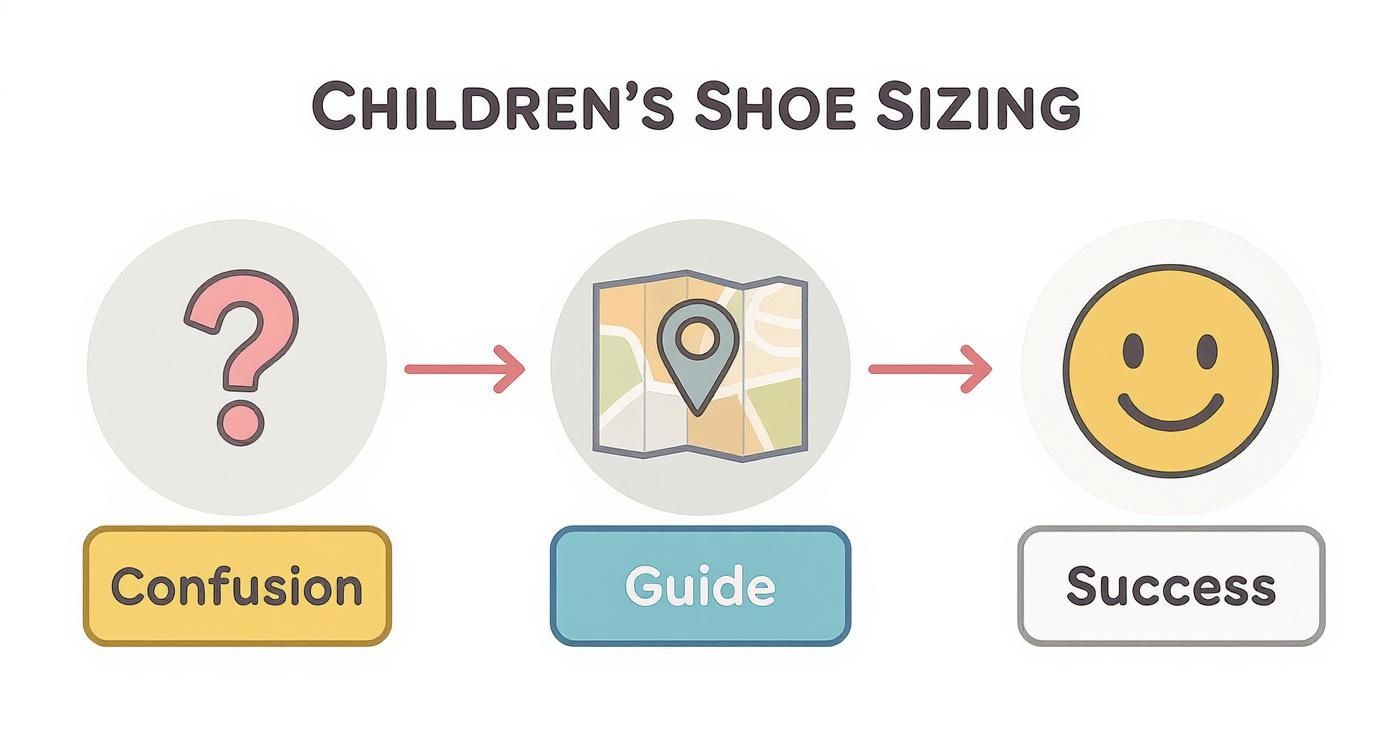
This simple flow chart captures that feeling of moving from uncertainty to success, all ending with the perfect fit.
The Foolproof Foot-Tracing Method
Okay, here's the main event! It’s time to capture that footprint. Don't worry, we have a few tricks to make this a breeze. Here’s a simple checklist to get you through the measurement process without a hitch.
Your Quick Guide to a Perfect Measurement
| Step | What To Do | Fun Tip |
|---|---|---|
| 1. Stand Tall | Have your child stand with their full weight on the paper. | Tell them to stand like a statue or a superhero! |
| 2. Trace Away | Carefully trace the outline of their foot with a pencil. | Keep the pencil straight up and down for the best results. |
| 3. Mark the Ends | Draw straight lines at the longest toe and the back of the heel. | This is like drawing the finish line for a race. |
| 4. Measure Up | Use a ruler to measure the distance between the two lines. | Let them "help" you read the numbers on the ruler. |
| 5. Repeat! | Always measure the other foot—they can be different sizes! | Call this "Round 2" and see if this foot is the "winner." |
When you have two different measurements, always go with the larger one to make sure there's plenty of room.
Timing and Tricks for Top-Notch Accuracy
Believe it or not, when you measure matters. Feet swell a bit throughout the day, so try to measure in the afternoon or evening for the most accurate childrens shoe sizing. For those ticklish toddlers, make it a game! Use distractions like a favorite toy or a silly song. The key is to keep things light and playful.
Cracking the Code of Kids' Shoe Size Charts
Ever stared at a shoe size chart and felt like you were trying to solve a puzzle? You’re not alone. The world of children's shoe sizing can feel like a secret code with US, UK, and EU numbers all jumbled together. But guess what? We’re about to crack it together.
Think of these sizing systems as different languages all trying to describe the same thing. A size 10 in the US isn't the same as a 10 in the UK, but once you get the hang of a few translation tricks, you’ll be navigating shoe charts like a pro.
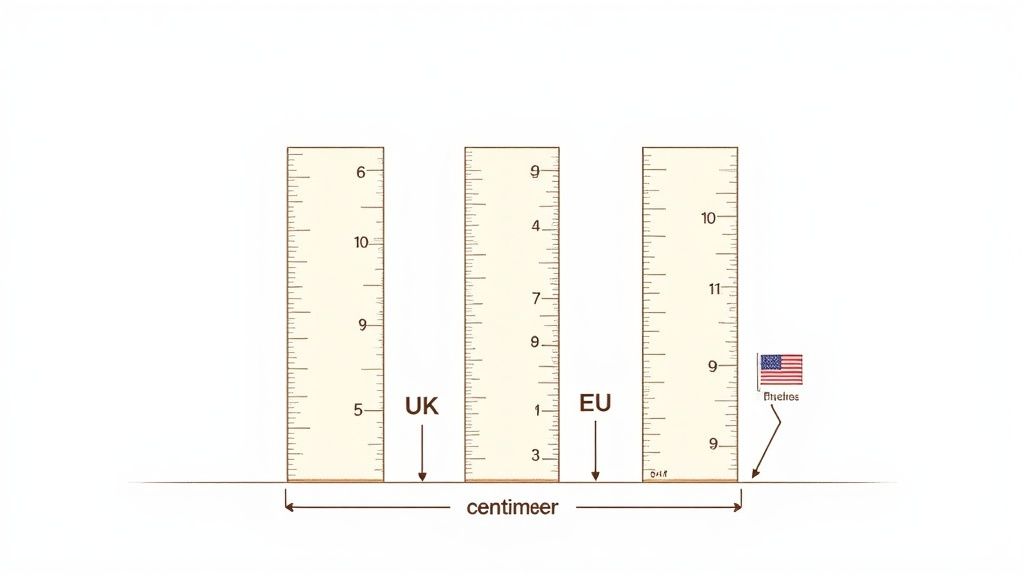
This mission to find the perfect fit can sometimes feel tricky. When faced with confusing charts, applying some universal problem-solving strategies can be a surprisingly simple way to break down the challenge.
The Big Three Sizing Systems
Let's meet the main players: US, UK, and EU sizes.
- US Sizing: This is what most of us in the States know. It starts with baby sizes, moves to toddler sizes ("T"), and then restarts at size 1 for big kids!
- UK Sizing: Our friends across the pond have a similar system, but their numbers are slightly different. A UK size is typically one size smaller than a US size.
- EU Sizing: European sizing uses larger numbers that increase continuously. It’s common in many popular brands.
Your secret weapon? The centimeter (cm) measurement you took! It's the universal language of feet. No matter the brand or country, a centimeter is always a centimeter, making it your most reliable guide.
Your Cheat Sheet for Quick Conversions
Navigating between these systems is where most parents get stuck. While every brand is a little different, here are some simple guidelines.
- US to UK: Subtract 1 size from the US number (e.g., US 5 = UK 4).
- US to EU: This one is trickier, but you'll generally add about 17 or 18 to the US toddler size.
For the most accurate fit, it’s always best to rely on a specific brand’s chart. Check out our detailed Pediped sizing guide to take all the guesswork out of your next purchase.
Mastering the Wiggle Room Rule for a Perfect Fit
High five! You've measured their feet and navigated the size charts. But getting the right size number is only half the battle. Now it’s time to nail the most important step in childrens shoe sizing: the fit. This is where the legendary "wiggle room" comes in.
A shoe needs to be a comfy home for your child's foot, with enough extra space for them to grow and stretch their toes.
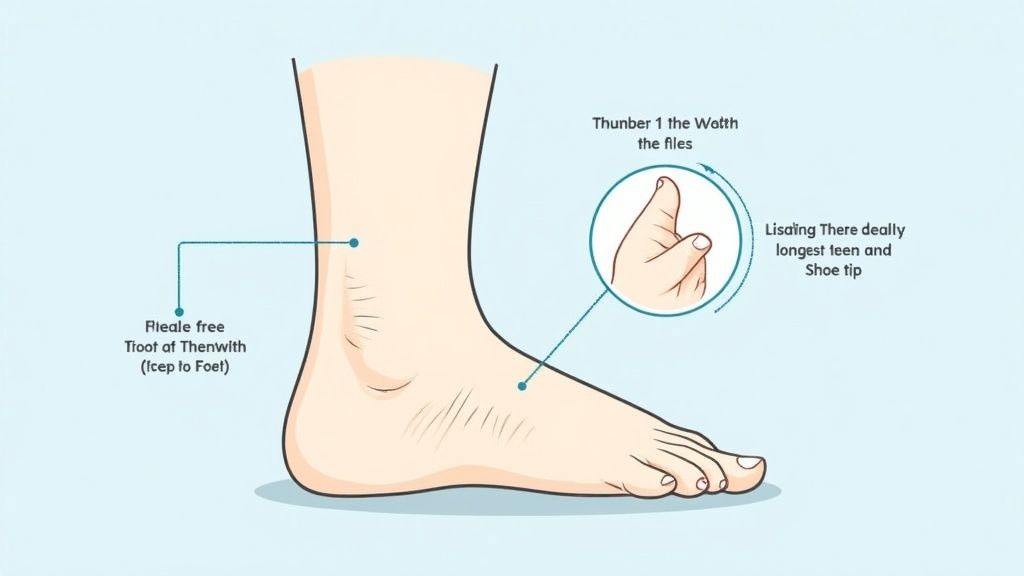
That extra room allows their toes to splay out and gives them a buffer for growth spurts.
The Famous Thumb Test
So, how much space is just right? It’s time for the thumb test. Once your child has the shoe on and is standing up, press your thumb down at the front of the shoe, right above their longest toe. You’re looking for about a thumb's width of space.
This sweet spot—roughly half an inch—is the perfect amount of wiggle room. It provides just the right amount of growing room without being so big that they trip.
Too little space can lead to cramped toes, while too much space can cause blisters. The thumb test helps you find that perfect balance.
Becoming a Fit Inspector
A great fit isn't just about length. Keep an eye out for a couple of common issues:
- The Dreaded Toe Crunch: This happens when a shoe is too narrow or short. Their toes should be able to lie flat and spread out naturally.
- The Slippery Heel Slip: This is a sign the shoe is too big. When they walk, their heel should stay put. If it's popping out, it’s going to cause rubbing and blisters.
Properly fitted footwear, including adaptive shoes, can make a world of difference. You can learn more about style and comfort in adaptive shoes for kids in our guide. By adding these quick checks, you’re guaranteeing a comfy home for your child's feet.
Navigating Your Pediped Journey, Stage by Stage
Okay, you're practically a pro! Now for the best part—picking out the perfect pair of shoes for your child's next adventure. Let's dive into Pediped's lineup, which parents absolutely love. They’ve designed a brilliant roadmap that grows with your child's feet.
Think of it as leveling up. Pediped keeps it easy with three clear stages: Originals, Grip ‘n’ Go, and Flex. It’s a complete journey, from that first wobbly step all the way to sprinting across the playground.
Starting Out with Originals
Welcome to the beginning of their walking adventure! Pediped Originals are for the tiniest feet, from newborns up to around age two. Originals have super-soft, flexible leather soles that feel as close to barefoot as you can get. This helps babies and new walkers feel the ground, building balance and a natural gait.
Want to learn more? Check out our guide on the best shoes for a baby learning to walk.
Gearing Up with Grip ‘n’ Go
Your little one has graduated from wobbles to confident toddles! This is where Pediped Grip ‘n’ Go comes in. Made for toddlers, these shoes strike the perfect balance between flexibility and support. They have soft rubber soles and feature special G2 Technology, with a cushioned heel and rounded edges to mimic the natural shape of a child’s foot.
Choosing the right footwear for each developmental stage is one of the best things you can do for your child's long-term foot health.
The toddler shoe market is a huge deal—the global kids' footwear market was valued at $47.76 billion in 2024. That just shows how important this stage is!
Stepping Up with Flex
Before you know it, you'll have a confident walker who runs and jumps with unstoppable energy. This is the moment for Pediped Flex, the ultimate shoe for active kids. Flex shoes feature durable rubber soles and the game-changing Flex Fit System. Every pair comes with an extra insole that can be inserted for a snug fit. As their foot grows, just take it out to extend the shoe's life. It’s a total win for parents!
Your Pediped Stage-by-Stage Guide
Here’s a quick-glance table to help you match the right Pediped line to your child's stage.
| Pediped Stage | Best For | Key Feature |
|---|---|---|
| Originals | Newborns, crawlers, and first-steppers (0-24 mos) | Ultra-soft, flexible leather soles for a "barefoot" feel. |
| Grip ‘n’ Go | Confident toddlers who are walking and exploring | G2 Technology with rounded edges and heel cushion for stability. |
| Flex | Active kids who are running, jumping, and playing | Durable rubber soles and the Flex Fit System to extend wear. |
From first steps to energetic sprints, Pediped has a shoe that grows with your child, making every step happy and healthy.
Common Shoe Sizing Questions Answered
You’ve got questions, we’ve got answers! Let's clear up any lingering confusion in the great adventure of childrens shoe sizing. We want you to feel 100% confident on your next shoe-shopping mission.
How Often Should I Measure My Child's Feet?
A child’s feet grow at lightning speed! Keeping up is the secret to avoiding too-tight shoes. Here’s a simple schedule:
- Toddlers (under 3): Measure every two to three months.
- Preschoolers (ages 3 to 5): Check their size every four months.
- Big kids (ages 6+): Measure every six months.
Of course, if your child says their shoes feel "ouchy," it’s time for a measurement check!
What’s the Deal with Shoe Widths?
Width is just as important as length! A shoe that’s too narrow will squish their toes, while one that's too wide lets their foot slide around. Some kids have wider or narrower feet, and many brands offer width options like W (Wide) or N (Narrow).
A quick trick to check the width: Pinch the material over the widest part of their foot. You should be able to grab a tiny bit. If you can't, it's too tight.
Should I Buy a Bigger Size for Them to Grow Into?
It's tempting to buy a size up, but it’s best to resist going too big. Shoes that are way too large can be a tripping hazard and cause blisters. That "thumb's width" of wiggle room is the perfect compromise—it gives them enough space to grow without sacrificing a safe fit.
Are Hand-Me-Down Shoes a Good Idea?
We all love a good hand-me-down, but shoes are one item you might want to buy new. A shoe's insole molds to the unique shape of a child's foot. When another child wears them, that pre-molded shoe can interfere with their own foot development. For the best support, starting with a fresh pair is always recommended.
Why Are My Child's Feet Different Sizes?
If you measured both feet and got two different numbers, don't worry! It's super common for one foot to be a bit larger than the other. When this happens, always, always buy the size that fits the larger foot. It's much more comfortable! For more tricky questions, our Pediped FAQ page is packed with helpful answers.
It’s no surprise parents focus on getting the right fit. The global children's shoe market is massive! In 2024, over 1.2 billion pairs of children's shoes were sold worldwide. That’s a lot of little feet to keep happy! You can discover more about the global children's footwear market on Market Growth Reports. With these answers, you’re ready for any shoe-sizing challenge. You’ve got this!
At Pediped, we're passionate about making sure every step your child takes is a healthy and comfortable one. From their first wobbly walk to their playground sprints, we have the perfect pediatrician-approved shoe for every stage. Explore our collection and find the perfect fit for your little adventurer at https://www.pediped.com.
Leave a comment